
Less than 5% of collision repair shops are digitally integrated with insurers.
CrashBay is building the first collision repair marketplace—a digital platform connecting carriers, repair shops, and drivers in one system.
Most claims still start with a phone call.
That’s the problem.
CrashBay is fixing it—by building the first collision repair marketplace platform, connecting carriers, fleets, shops, and drivers through a single, API-first system.
It’s like Airbnb—but for collision repair.
Every stakeholder connects on one seamless platform built for speed, transparency, and trust.
When I joined as fractional CMO, my role wasn’t to redesign the brand.
It was to help define the category—to turn a promising tech company into a scalable, trusted platform for an industry ready to evolve.
Step 1: Defining the Platform and the Category
Every great category starts with a clear problem.
CrashBay’s vision was clear: digitize and streamline a $40B industry still operating like it’s 1998.
For CrashBay, the opportunity was obvious: unlock the 70% of repair capacity traditional DRP programs miss.
The challenge?
No one had ever positioned collision repair as a platform problem before.
CrashBay’s model bridged that gap.
Think “Airbnb for collision repair”—a digital marketplace connecting all three stakeholders on a single platform.
Our first task? Define the category and the story that would make it undeniable.
We rebuilt the narrative from insurtech tool to industry infrastructure.
We rebuilt CrashBay’s narrative from the inside out:
- Reframed positioning from “auto repair tech” to “The Collision Repair Marketplace.”
- Aligned every audience—car owners, repair shops, and carriers/fleets—around one system.
- Clarified messaging across internal teams, product, and investors so the business spoke one unified language.
- Shifted the story from “software” to infrastructure—a platform that powers the entire collision ecosystem.
CrashBay wasn’t just another SaaS—it became the digital backbone of modern repair.
Step 2: Branding as a Competitive Edge
Branding isn’t about how it looks.
It’s about how it works.
The brands that win today don’t just market well—they’re built on a clear system of meaning. One that shapes how teams make decisions, how customers connect, and how the business scales.
For CrashBay, brand became that system. It defined who the company serves, how it delivers value, and why it matters.
Through messaging, positioning, and audience strategy, we helped CrashBay:
- Clarify the customers that matter most—carriers, shops, and vehicle owners.
- Build tailored value propositions for each without diluting the platform story.
- Align internal teams, partners, and investors around a single, unified vision.
By building a messaging hierarchy, we could tailor every communication—whether it was a carrier pitch, shop onboarding, or product demo—around relevant, measurable value.

The result:
- A consistent narrative across channels and teams
- Messaging that made the platform’s value obvious to every stakeholder
- An internal understanding of how to talk about the business, confidently and consistently
This wasn’t surface-level storytelling—it was operational clarity disguised as branding.
And when that happens, every part of the company benefits: product decisions get sharper, marketing converts faster, and customer loyalty deepens.
Because when your brand is built to compete, it’s not just what people remember—it’s what keeps them coming back.
Step 3: Turning the Platform Into Performance
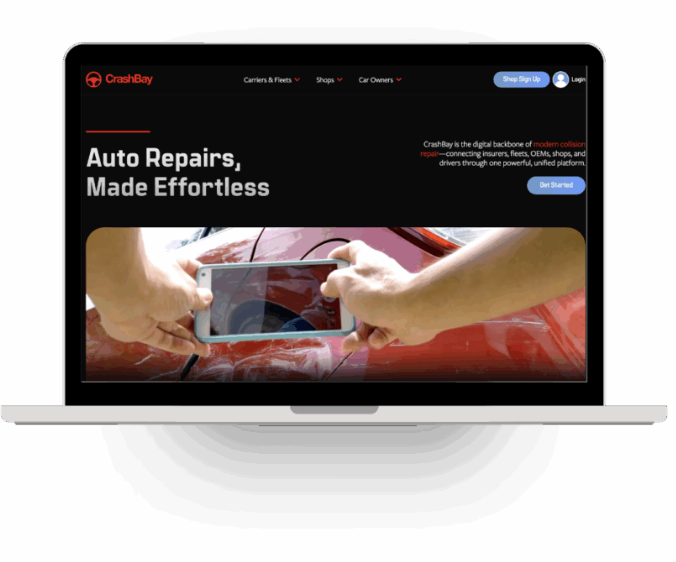
We relaunched CrashBay 2.0 with a clear goal: not more traffic—better traffic.
And it worked.
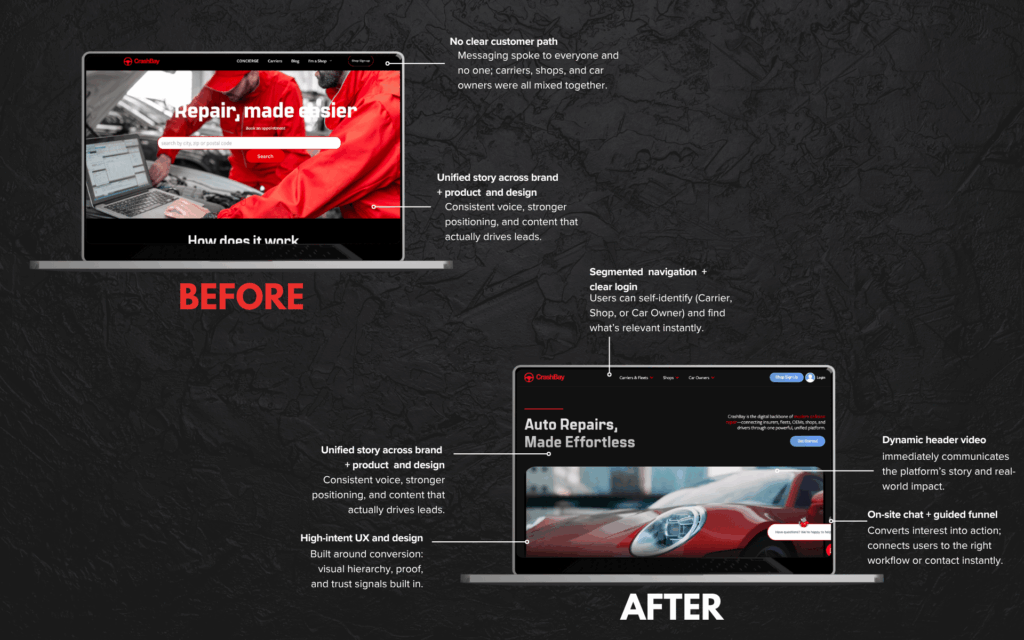
CrashBay’s website wasn’t just rebuilt—it was redesigned around the customer journey.
The new site didn’t just drive engagement—it positioned CrashBay as the go-to collision repair marketplace for insurers and repair partners.
It became a front door to the platform, integrating marketing, product, and sales in one experience.
After launch, the results spoke for themselves:
- Visitors spent 58% longer on-site post-launch
- Engagement quality improved significantly across high-intent pages like Shop Locator (+42%) and Concierge (+39%) = conversion indicators for CrashBay
- Funnel activity increased, with higher user intent and improved conversion flow from inbound to platform activation
- Time on page increased while bounce rate dropped—proof that the new design was attracting fewer but far more valuable visitors
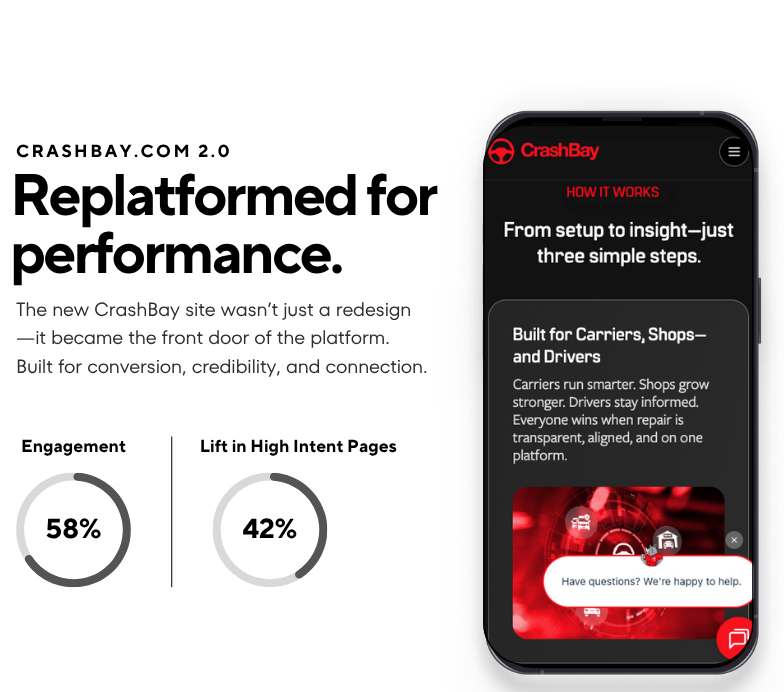
The foundation is now set for scalable growth: as organic visibility rebuilds, the site continues converting higher-intent users more effectively.
CrashBay’s website became more than a marketing hub—it became the front door of the platform, connecting inbound demand from carriers and shops directly into product workflows.
Step 4: Building Loyalty and Recurring Revenue
In an industry that’s typically one-and-done, we helped CrashBay build loyalty into the business model itself.
The vision: make recurring engagement the growth flywheel.
By architecting a membership and rewards framework for repair shops and carriers, the platform began creating the baseline for predictable MRR—transforming transactions into long-term relationships.
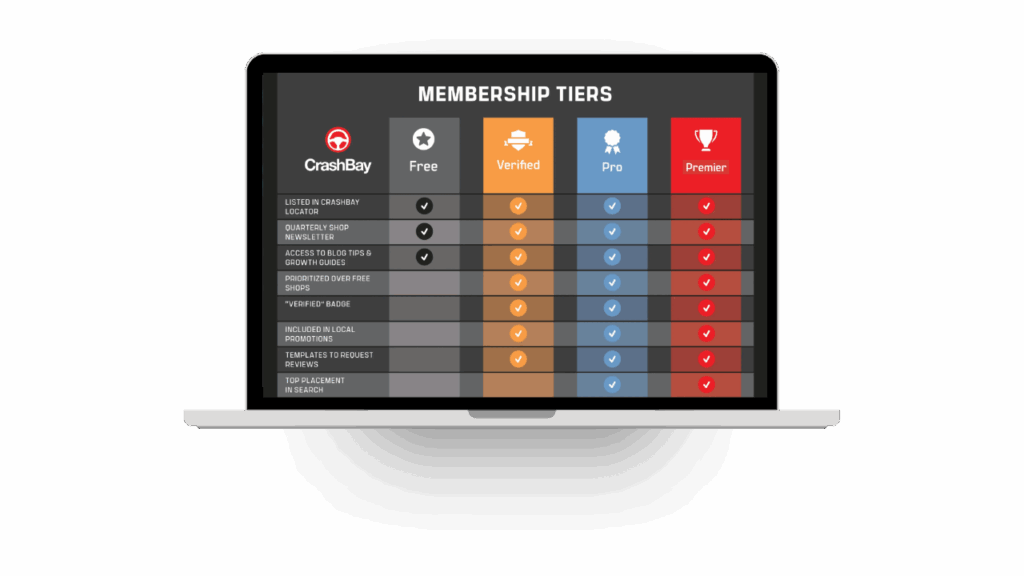
It’s a loyalty and membership system for shops that turned engagement into recurring revenue.
By productizing loyalty, we made growth predictable.
Each claim processed on the platform generated shop subscriptions and SaaS fees—creating a flywheel effect across the ecosystem:
Loyalty isn’t a marketing tactic. It’s retention as a business strategy.
And when it compounds, it builds both revenue and resilience.
Step 5: Guiding the Fundraise
As CrashBay prepared for its seed round, I was commissioned to work closely with the founders to refine the investor narrative—translating platform traction and TAM into a story that captured both financial and operational opportunity.
We overhauled the pitch positioning, clarified investor messaging, and tied the platform’s evolution directly to future growth levers.
The result was a narrative investors could underwrite—not just believe in—anchored in systems, performance, and early proof of scalability.
It wasn’t just about raising capital.
It was about raising alignment—between investors, partners, and the next phase of growth.

The Takeaway
This wasn’t about branding a tech company.
It was about building a platform that defines how the next era of collision repair will work.
The best marketing doesn’t look like marketing.
It looks like momentum.
It drives sales, earns trust, and turns investors into believers.
Because when the story, the product, and the customer all move in the same direction—
that’s not a campaign.
That’s a growth engine.
Follow Along
For founder POVs by Tiffany Cooley, frameworks, and strategy deep dives:

Related:
What Tiffany Cooley, founder of Brand + Growth Co. does as a Fractional CMO


Comments +